Concept redesign by Midscale. Talkround is a fictional brand; every name, score and number on this page is sample data.A Midscale concept · sample data · Read the case study →
Get started

Talkround · First-round interviews

First-round interviews that listen to every candidate.

Talkround asks every applicant the same few questions, by voice or in writing, whenever it suits them. Your team gets a ranked shortlist with the evidence behind every score. A person makes every decision.

Free to try with one role. No card, no sales call.

Candidate · Q1“Five usability sessions changed our whole plan.”
Candidate · Q3“We tested both versions with three users each.”
Talkround“Take your time. There’s no countdown.”
LISTENING
Same questions for every candidateSpeak or type, their choiceEvery score quotes the answerA person approves every declineNo face or emotion analysisEveryone hears back
Sample role · Product Designer

240 applicants

0go to a person for review
0get a kind, approved reply

Your shortlist

0 ready for a person · illustration
The usual wayWith Talkround

A recruiter skims 240 CVs, books 30 phone screens and asks the same five questions thirty times. The best candidate accepts a faster offer on Thursday.

The usual way

A recruiter’s week

Mon
Job post goes liveApplications pile up faster than anyone can read them.
Tue
Skim CVs, one by oneKeywords and job titles decide who gets a call.
Wed
Phone screens all daySame questions, asked a little differently each time.
Thu
Best candidate takes another offerThey were waiting for a call slot.
Fri
Shortlist from memoryMost applicants never hear back.
With Talkround

The same week

Mon
Job post goes live with an interview linkEvery applicant can answer, evenings included.
Tue
Answers come in, by voice or textSame four questions for everyone.
Wed
Draft notes arrive with quotesEach score links to what was actually said.
Thu
You review the shortlist, then the borderline onesA person decides. The AI only suggests.
Fri
Team interviews bookedEveryone else has heard back, kindly.

An illustrative week, not measured results

What it does

Five jobs, one first round.

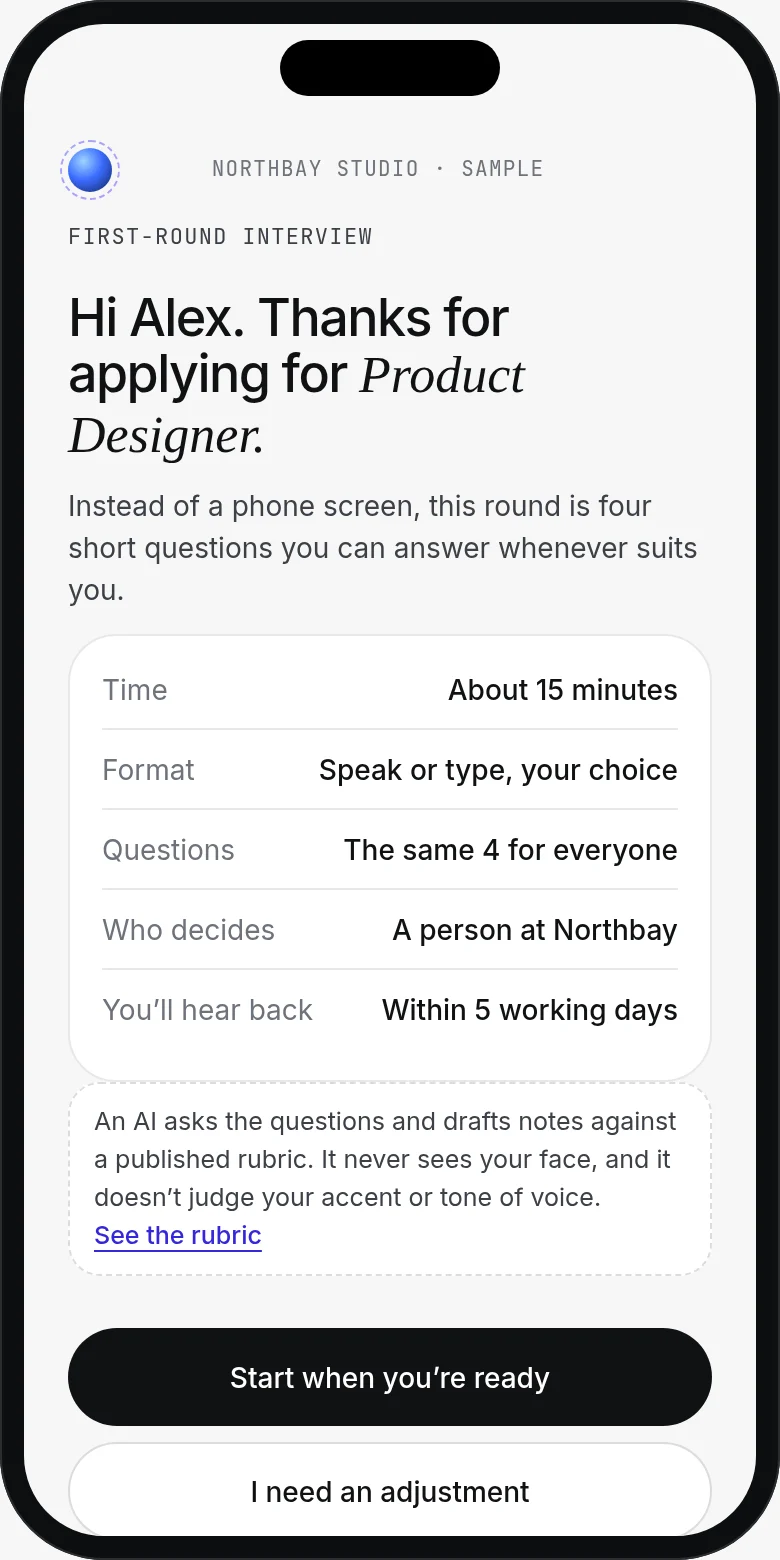
Candidate invite screen: time, format, who decides and when they will hear back
01 · Invites

Sets expectations

Every invite says how long it takes, who decides and when they’ll hear back.
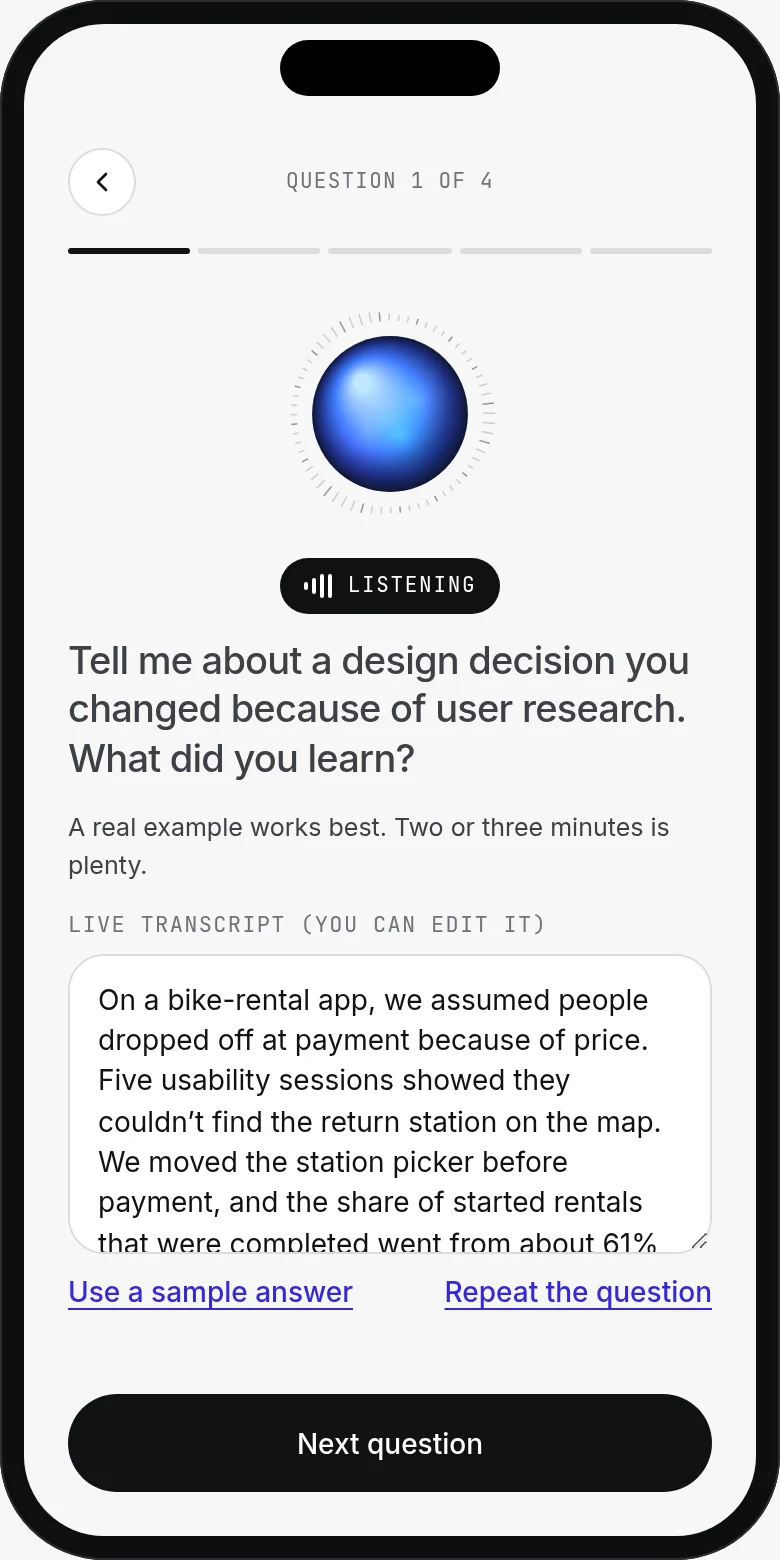
Interview screen with the listening orb, question one and a live transcript
02 · Interviews

Asks, then listens

The same structured questions for everyone, by voice or text. No countdown.
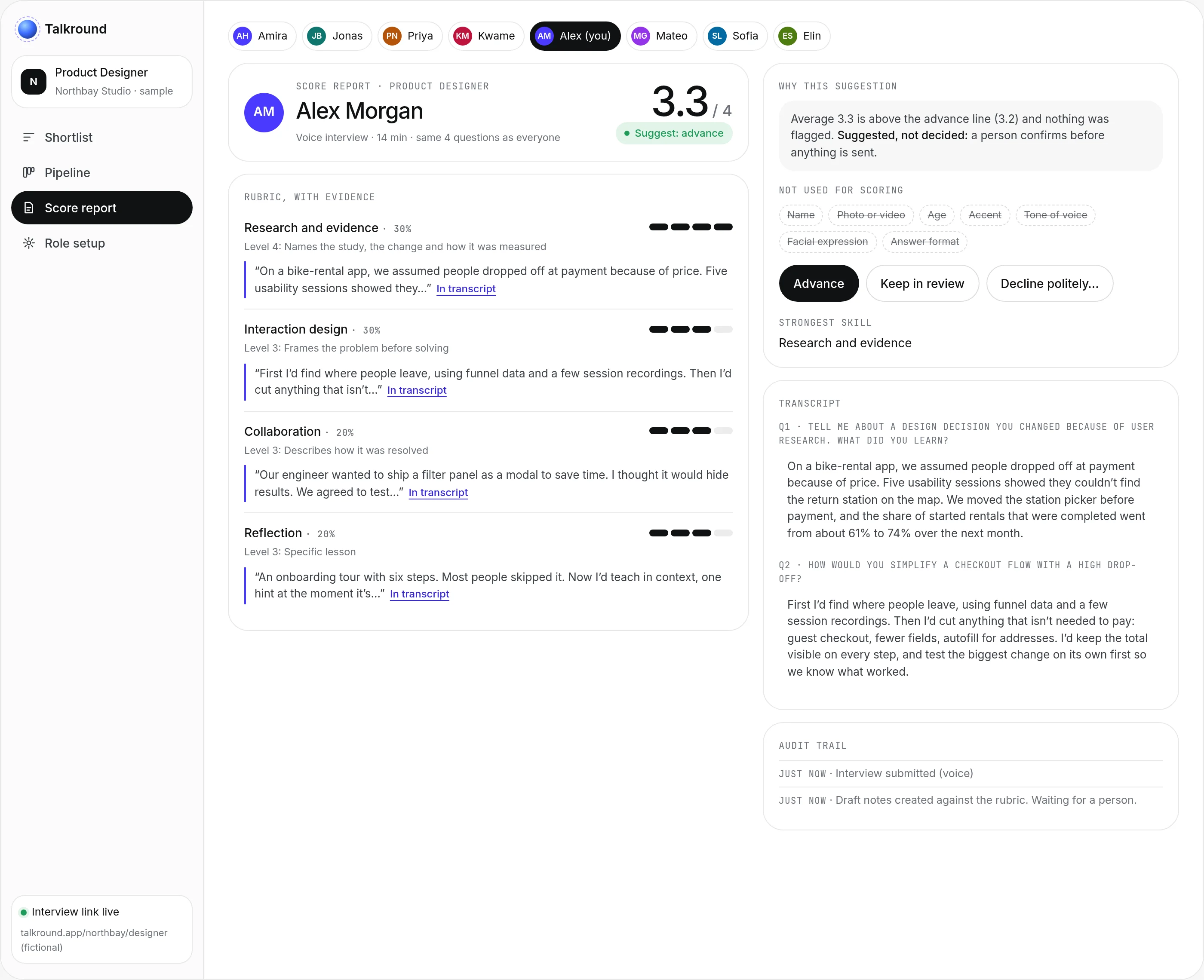
Score report with rubric levels and quoted evidence
03 · Scores

Quotes the evidence

Each rubric level links to the words that earned it. No mystery numbers.
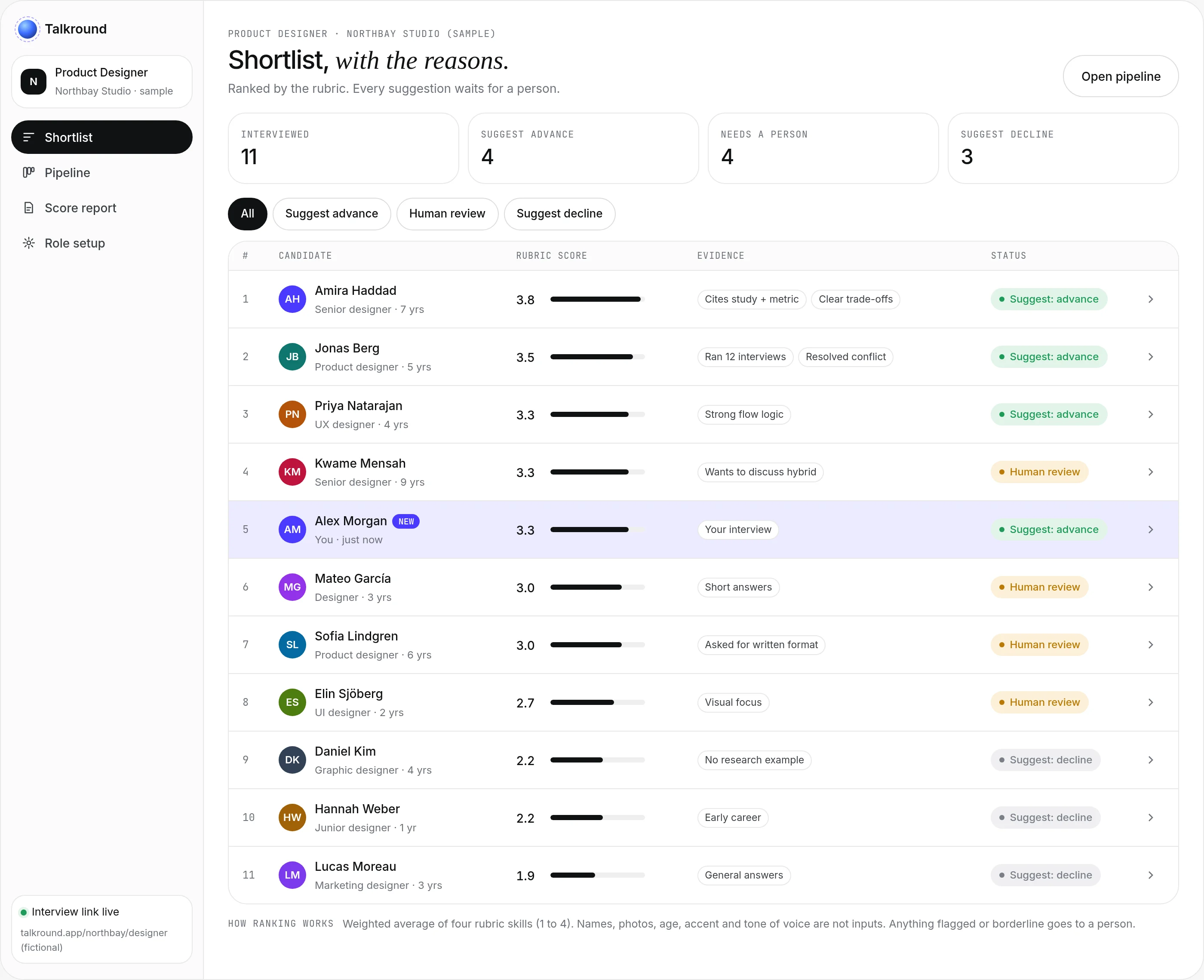
Ranked shortlist with evidence tags and status
04 · Routes

Sorts, never rejects

Strong, borderline and weak go to different queues. Every decision is a person’s.
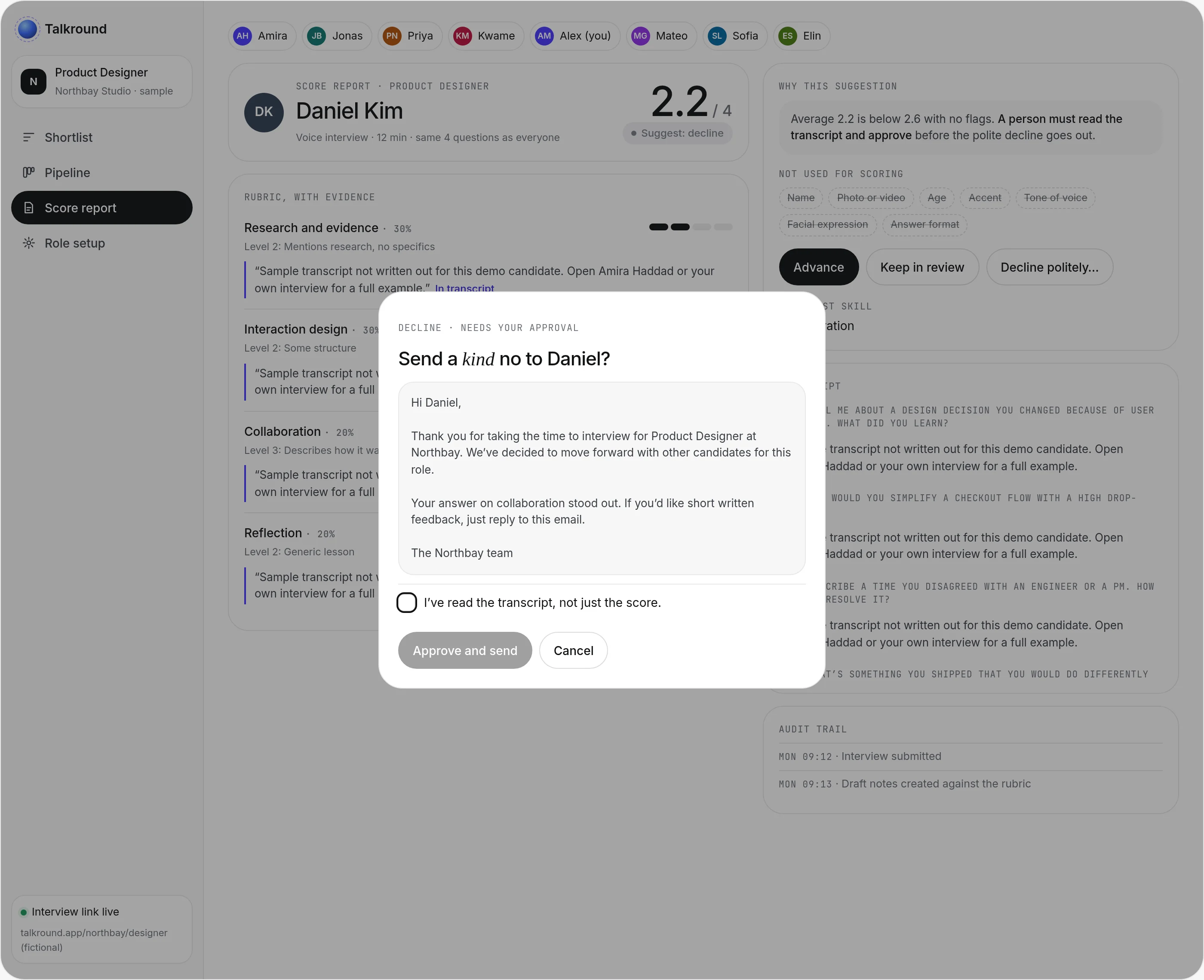
Approval dialog for a kind decline message
05 · Replies

Closes the loop kindly

A warm, specific no, sent only after a person reads the transcript.

01 / 05Scroll
How it works

Set up. Interview. Score. Shortlist.

01 · Set up the role

Write the questions once.

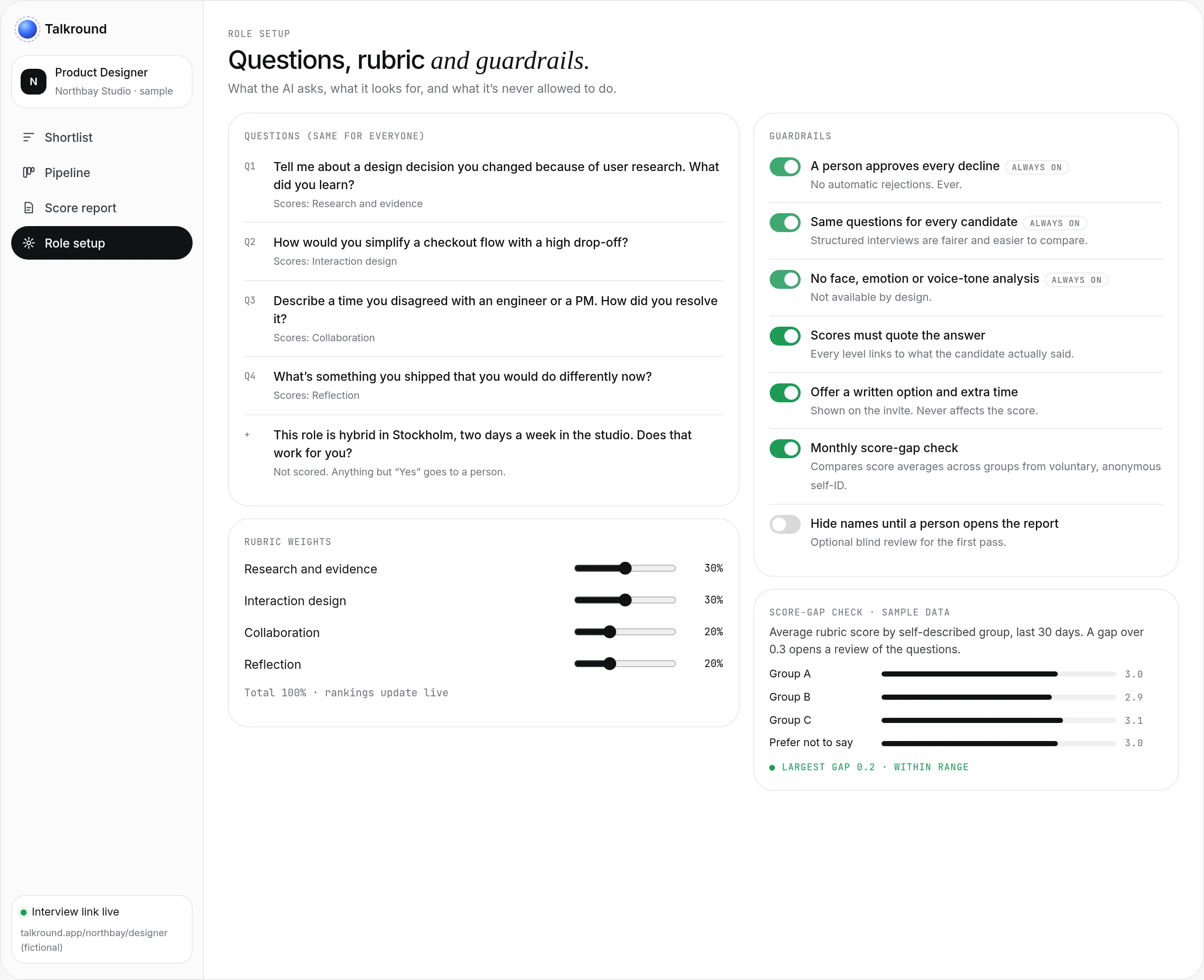
Pick four questions and a rubric with plain-English levels. Set the guardrails. It takes about as long as writing the job post.

  • Rubric weights you can see and change
  • Guardrails that can’t be switched off
02 · Interview

Every candidate gets the same chance.

Candidates answer when it suits them, by voice or in writing, with no timer and a chance to edit before sending.

  • Adjustments on the invite, not hidden in a FAQ
  • Logistics questions never auto-reject
03 · Score

Notes that show their work.

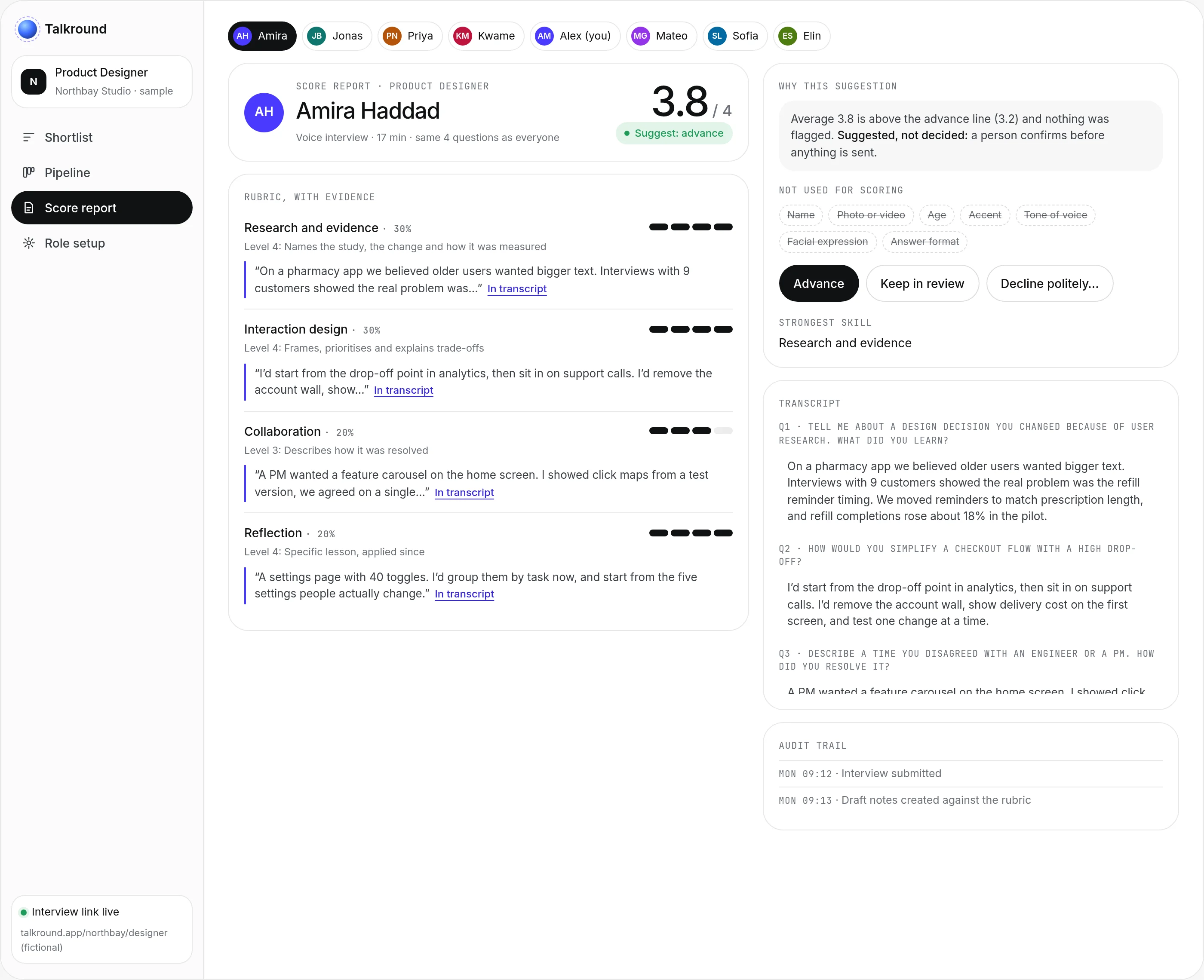
Each answer gets a rubric level and a quote. The report lists what was not used: name, face, accent, tone of voice.

  • Levels from 1 to 4, not fake-precise percentages
  • Jump from any score to the transcript
04 · Shortlist

You decide. Kindly.

Advance, keep in review or decline. A decline needs a person to read the transcript first, then a warm message goes out.
  • Everyone hears back within five working days
  • Full audit trail per candidate
Role setup: questions, rubric weights and guardrailsRole setup
Candidate answering question oneCandidate interview
Score report for a sample candidateScore report
Ranked shortlistShortlist
01Set up
02Interview
03Score
04Shortlist
Behind every score

The rubric behind every score.

Each answer is matched to skills, and each skill to plain-English levels. Follow one answer from the question to the evidence to the level it earned.

Evidence foundSkills and signals
Rubric map · sample roleSample data
Question 1Research
  1. “five usability sessions”
  2. names the change it caused
  3. measured: 61% → 74%
  4. level 4 anchor met
Rubric levelResearch · L4
Q2 · InteractionL3
Q3 · CollaborationL3
Q4 · ReflectionL3
Routing

Every interview goes somewhere sensible.

Talkround suggests. People decide. Nothing leaves the building without someone reading it.

INTERVIEW COMPLETE 3.3 / 4
Suggest: advance3.2+

Advance

Above the line and nothing flagged. A person confirms, then a booking link goes out.

Amira H.3.8
Jonas B.3.5
Priya N.3.3
Human reviewFlags

A person looks first

Borderline scores, short answers, audio trouble, an adjustment or a logistics question. No suggestion until someone has looked.

Kwame M.Wants to discuss hybrid
Sofia L.Written format
Suggest: decline< 2.6

A kind, approved no

Sent only after a person reads the transcript, with one specific strength and an offer of feedback.

“Your answer on collaboration stood out. If you’d like short written feedback, just reply.”
Your team’s side

Lands where your team already works.

The shortlist moves into the tools you use. Example integrations for this concept.

Shortlist ready
Product Designer · 8 people
Your ATSExample

Stages stay in sync

Advanced candidates move to “Team interview”, with the score report attached.

StageTeam interview
AttachedScore report (PDF)
CalendarExample

Interviews book themselves

Candidates pick a slot from the panel’s shared availability.

Mon
Tue
Wed
Thu
Fri
Thu 14:00 · Team interview · Amira H.
SlackExample

A nudge, not noise

One daily message when reports are waiting for a person.

#hiring-design
3 reports need a person today. Oldest: 2 days.
Score reports

A score report you can argue with.

Levels, quotes and the reason for every suggestion. If you disagree, you can see exactly where.

Talkround score report: rubric levels with quoted evidence, why this suggestion, what was not used for scoring, and the transcript
Rubric levels, this roleSample

How 11 interviews scored

1
10
24
9
Level 1Level 2Level 3Level 4
Average level per questionSample

Where candidates struggled: reflection

Q1 Research2.9
Q2 Interaction2.9
Q3 Collaboration3.1
Q4 Reflection2.8
Guardrails

Fair by design. Checked every month.

An AI in hiring has to earn trust from both sides. These rules are built into the product, and the first three can’t be switched off.

  • A person approves every declineNo automatic rejections. Ever.
  • Same questions for every candidateStructured, comparable, explainable.
  • No face, emotion or voice-tone analysisNot offered, by design.
  • Every score quotes the answerClick through to the transcript.
  • Written option and extra time, on the inviteNever affects the score.
  • Monthly score-gap checkScore averages compared across groups, from voluntary self-ID.
Stress test · candidate questions● Live
CandidateWill a robot reject me?
TalkroundNo. I ask the questions and write notes. A person at Northbay reads them and makes the decision. You’ll hear back either way within five working days.
CandidateCan I write my answers instead? I stutter when I’m nervous.
TalkroundOf course. Tap “Type” on any question. The format never changes your score, and nobody sees which one you used unless you tell them.
CandidateDo you look at my face?
TalkroundNo. There’s no camera, and I don’t judge accent or tone of voice. Only what you say, against the published rubric.
Design noteAI used to screen job candidates is treated as high-risk under the EU AI Act, and emotion recognition at work is restricted. This concept is designed so people stay in charge. It is a design decision, not legal advice.
Pricing

Start with one role, free.

Try it on a real opening. If it doesn’t save your team time, you’ll know within a week. Sample pricing model

  • One live role free, no card needed
  • Then a flat monthly price per active role
  • Unlimited candidates and reviewers on every plan
  • Export everything, cancel any time
Try it on one role
Questions

Before you ask the orb.

No. It asks the questions, transcribes and drafts notes against your rubric. A person advances, reviews or declines every candidate, and a decline can’t be sent until someone has read the transcript.

Only the words of each answer, against the rubric you wrote. It never sees a face, and it doesn’t use name, age, accent, tone of voice or answer format.

Yes, on any question, and they can ask for extra time on the invite. The format is never an input to the score.

Structured questions, quoted evidence and human decisions come first. Every month, score averages are compared across groups using voluntary, anonymous self-ID, and a gap over 0.3 opens a review of the questions.

In this concept, shortlists sync to your ATS stages, calendars and Slack. A real product would list each supported tool by name, with what syncs and what doesn’t.

Answers are kept for the role only and deleted after six months, unless the candidate agrees to be considered for other roles. Candidates can ask for a copy or deletion at any time.

Estimate

What does your first round cost you?

Applicants per role120
20260500
Hours today
With Talkround
Hours back

This is an estimate, not a result. Assumptions: today, 6 minutes to skim each CV and a 25-minute phone screen for 15% of applicants. With Talkround, 60% of applicants complete the interview; a person reads 25% of those reports in full (8 minutes each) and skims the rest (1 minute each). Setup time isn’t included.

Candidates heard today18
Candidates heard with Talkround72

Hear every candidate. Hire the right one.